
Researching Arthrosamid for Knee Pain?
There's a Proven, Medicare-Covered Option.
JRI specializes in fluoroscopy-guided gel injections — FDA-approved, Medicare-covered, and backed by decades of clinical evidence. Available now at 5 convenient locations.
Or call now: (800) 238-9307
*Based on 400K+ actual patient billing records at Joint Relief Institute. Individual costs vary.
Two Very Different Paths for Knee Pain
Arthrosamid
- Not FDA-approved — unavailable in the US
- Not covered by Medicare or any US insurance
- $2,500–$4,500 per knee, cash only
- Non-reversible — integrates permanently into tissue
- 1 RCT with 239 patients (limited evidence)
- Higher adverse event rate (28.9% vs 7.6%)
- No FDA regulatory recourse if complications arise
- Requires travel to Canada or Europe
JRI Gel Injections
- FDA-approved since 1997 (16+ products)
- Medicare-covered for knee osteoarthritis
- 93% of patient visits = $0 out of pocket*
- Reversible — body absorbs HA naturally
- Decades of evidence, millions treated worldwide
- Fluoroscopy-guided for 100% joint accuracy
- 40,000+ patients treated at JRI
- Walk out same day, no downtime
Key fact: The only head-to-head RCT (ROSA study) showed Arthrosamid was non-inferior to hyaluronic acid — not superior. Both treatments reduce pain. The difference is that gel injections have 25+ years of real-world evidence, FDA approval, and Medicare coverage.
What Is Arthrosamid?
Arthrosamid is an injectable polyacrylamide hydrogel (2.5% polyacrylamide, 97.5% water) manufactured by Contura International in Denmark. Unlike hyaluronic acid gel injections that lubricate the joint space, Arthrosamid integrates into the synovial membrane tissue, creating a permanent cushioning scaffold.
The treatment involves a single 6 mL injection intended to provide multi-year relief. It is CE-marked in the EU/UK (since 2021) and approved in Canada (2024), but has no FDA approval and no confirmed timeline for US availability.
Because the hydrogel is non-biodegradable, it does not break down — which is marketed as an advantage but also means the treatment cannot be reversed if complications arise. Long-term safety data beyond 5 years in large populations remains limited.
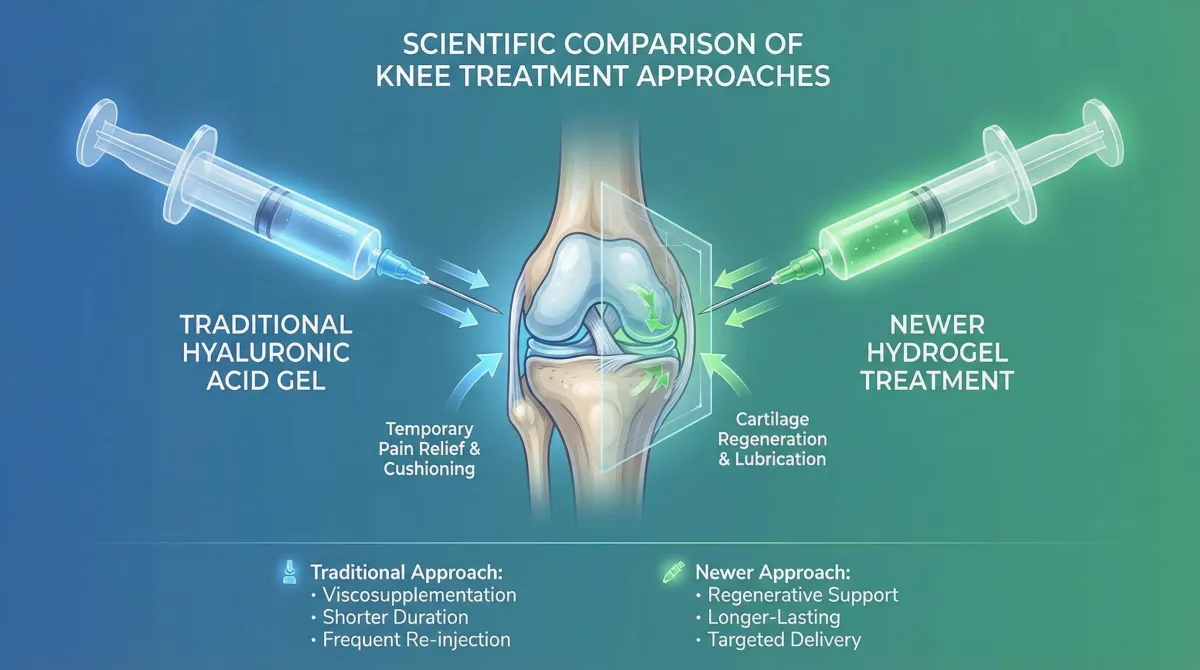
Side-by-Side Comparison
| Category | Arthrosamid | Gel Injections (HA) |
|---|---|---|
| FDA approved (US) | No — not available in the US | Yes — 16+ products approved since 1997 |
| Available in the US | No | Yes — widely available |
| Medicare coverage | No | Yes — Part B covers for qualifying patients |
| Cost per treatment | $2,500–$4,500 (cash only) | 93% of patient visits = $0 out of pocket* |
| Duration of relief | 2–5+ years (limited long-term data) | 6–12 months (well-documented, improves each course) |
| Repeatable | Intended as one-time; repeat data limited | Yes — every 6 months, outcomes improve with each course |
| Clinical evidence | 1 RCT (239 patients), small long-term studies | Decades of data, millions of patients worldwide |
| Adverse events (RCT) | 28.9% mild/moderate | 7.6% mild/moderate |
*Based on 400K+ actual patient billing records at Joint Relief Institute. Individual costs vary.
“But Arthrosamid Is a Single Injection That Lasts Years…”
That's the key appeal — and we understand why it's attractive. But here's the full picture:
The ROSA trial showed the pain difference vs. gel injections was NOT statistically significant at 52 weeks
Gel injection outcomes improve with each course — 66% improvement after multiple courses over 6 years
Each gel injection series is covered by Medicare, so you pay little to nothing each time
Arthrosamid is non-reversible — if complications arise, the hydrogel cannot be removed
Long-term data beyond 5 years in large populations does not yet exist for Arthrosamid
“We're not against Arthrosamid — the early data is genuinely interesting. But we believe patients deserve treatments backed by decades of evidence, FDA approval, and insurance coverage before committing to a newer, irreversible, and expensive alternative.”
What Joint Relief Institute Offers
You don't need to wait years or travel abroad for an effective, non-surgical knee pain treatment. Here's what's available now.
10+ FDA-Approved Formulations
Not all gel injections are the same. JRI offers over 10 hyaluronic acid products, matched to your specific arthritis severity, joint size, and treatment history. This personalized approach means better outcomes.
Fluoroscopy-Guided Precision
Every injection uses real-time X-ray imaging to confirm the needle is placed precisely inside the joint. Studies show blind injections miss up to 30% of the time. At JRI, every injection is confirmed.
Outcomes Improve Over Time
Unlike a single injection you hope works, gel injection outcomes get better with each 6-month course. A multi-practice study showed up to 66% improvement after multiple courses — and each series is typically covered by Medicare.
Specialized, Board-Certified Physicians
JRI physicians specialize exclusively in joint injections. With 400,000+ procedures performed, our team has more experience with viscosupplementation than virtually any practice in the country.
Why Fluoroscopy Matters: Injection Accuracy
Up to 30% of injections miss the joint entirely
Real-time X-ray confirms every injection reaches the joint
Your Treatment Process
What Patients Say
My knees feel wonderful and brand new after my injections. I was scared of surgery but this worked beautifully.
My sister got relief with just 3 injections — no surgery needed! Anybody with knee pain, I recommend here. Now I'm ready for my cruise!
I wish that I had gone to them earlier. They told me exactly what my Medicare would cover. Courteous, concerned, and highly professional.
5 Convenient Locations
Chicagoland clinics in Glenview, Oak Brook, Orland Park, and Stony Island — plus our Minneapolis-area clinic in Edina, MN.
Don't Spend $4,500+ Before You Understand Your Covered Options
Arthrosamid costs $2,500–$4,500 per knee — plus international travel — with no insurance coverage. At JRI, most patients pay $0 out of pocket with Medicare.
Check Your Insurance Coverage
Medicare and most insurance plans accepted
Frequently Asked Questions
Q1. Is Arthrosamid available in the United States?
No. As of March 2026, Arthrosamid is not FDA-approved and is not available at any US clinic. It is approved in the EU/UK (since 2021) and Canada (since 2024). The nearest access point for US patients is Canada, where NeuPath Health began offering it in March 2025. There is no confirmed timeline for FDA approval.
Q2. Is Arthrosamid better than gel injections?
The only head-to-head randomized trial (ROSA study, 239 patients) compared Arthrosamid to Synvisc-One. At 52 weeks, Arthrosamid showed a numerical advantage in pain scores but the difference was NOT statistically significant — meaning the study could not confirm superiority. Arthrosamid did show a higher adverse event rate (28.9% vs 7.6%).
Q3. Does Medicare cover Arthrosamid?
No. Arthrosamid is not available in the United States and is not covered by Medicare, Medicare Advantage, or any US insurance plan. If you travel abroad for the treatment, it would be entirely out of pocket. Hyaluronic acid gel injections are covered by Medicare Part B for qualifying patients with knee osteoarthritis.
Q4. What are gel injections and how do they work?
Gel injections (viscosupplementation) use hyaluronic acid — a substance naturally found in joint fluid — to restore lubrication and cushioning inside arthritic joints. They reduce bone-on-bone friction and inflammation, providing months of pain relief without surgery, drugs, or downtime.
Q5. Does Medicare cover gel injections for knee pain?
Yes. Medicare Part B covers hyaluronic acid gel injections for knee osteoarthritis when deemed medically necessary. At JRI, 98.5% of Medicare patients have paid $0 out of pocket. We verify your coverage before your first visit so there are no surprise bills.
Q6. How long does relief from gel injections last?
Most patients experience 6–12 months of relief per treatment series. Outcomes typically improve with each course — a multi-practice study showed up to 66% improvement after multiple courses over 6 years. Because gel injections are repeatable and Medicare-covered, patients can maintain long-term relief.
Q7. What is fluoroscopy and why does it matter?
Fluoroscopy is real-time X-ray imaging used during injection to confirm the needle is placed precisely inside the joint space. Studies show blind (unguided) injections miss the joint up to 30% of the time. JRI uses fluoroscopy on every injection for 100% confirmed joint placement, which directly impacts how well the treatment works.
Q8. Will Joint Relief Institute offer Arthrosamid in the future?
We are monitoring Arthrosamid’s clinical evidence and regulatory progress with interest. If and when it receives FDA approval and demonstrates a strong long-term safety profile, we will evaluate whether to offer it alongside our existing treatments. Our commitment is to provide treatments backed by the strongest available evidence.
Get the Facts Before You Decide
Schedule a no-obligation evaluation. Our board-certified physicians will examine your knee and help you understand which treatment option is best for your specific condition.
Or call us: (800) 238-9307
Sources
[1] ROSA Study: Randomized trial comparing Arthrosamid vs. Synvisc-One. OARSI, 2022.
[2] Long-Term Outcomes of Viscosupplementation: Multi-Practice Study. PMC, 2021.
[3] NeuPath Health: First North American Arthrosamid provider. BusinessWire, March 2025.
[4] Accuracy of Blind vs. Image-Guided Intra-Articular Knee Injections. J Clinical Medicine, 2022.
[5] EUROVISCO Consensus Guidelines for HA Viscosupplementation. J Orthopaedic Surgery and Research, 2024.
[6] Medicare Coverage Database: Hyaluronic Acid Injections for Knee OA. CMS, 2025.