
Viscosupplementation:
The Complete Guide to Knee Gel Injections
Learn how viscosupplementation restores your knee's natural cushioning without surgery. 12+ FDA-approved gel options, fluoroscopy-guided for 100% accurate placement, at 4 Chicagoland locations.
Or call now: (800) 238-9307
*Based on 400K+ actual patient billing records at Joint Relief Institute. Individual costs vary.
What Is Viscosupplementation?
Viscosupplementation is an FDA-approved treatment that restores the natural cushioning inside your knee joint. It works by injecting a medical-grade gel made of hyaluronic acid (HA) directly into the joint space.
Healthy knees produce synovial fluid rich in hyaluronic acid — a thick, gel-like substance that acts as both a lubricant and a shock absorber. When osteoarthritis breaks down cartilage, this fluid becomes thin and depleted. Bones begin rubbing together, causing pain, stiffness, and inflammation.
Viscosupplementation replaces what the body has lost. The injected gel coats joint surfaces, reduces friction between bones, absorbs impact, and can provide meaningful pain relief lasting 6 to 12 months per treatment course.
While cortisone reduces inflammation and provides fast short-term relief, viscosupplementation addresses the mechanical cause of your pain — the loss of natural joint lubrication. At JRI, we typically combine both: cortisone for immediate relief and gel for lasting cushioning. And unlike surgery, it requires no hospital stay, no general anesthesia, and no recovery downtime.
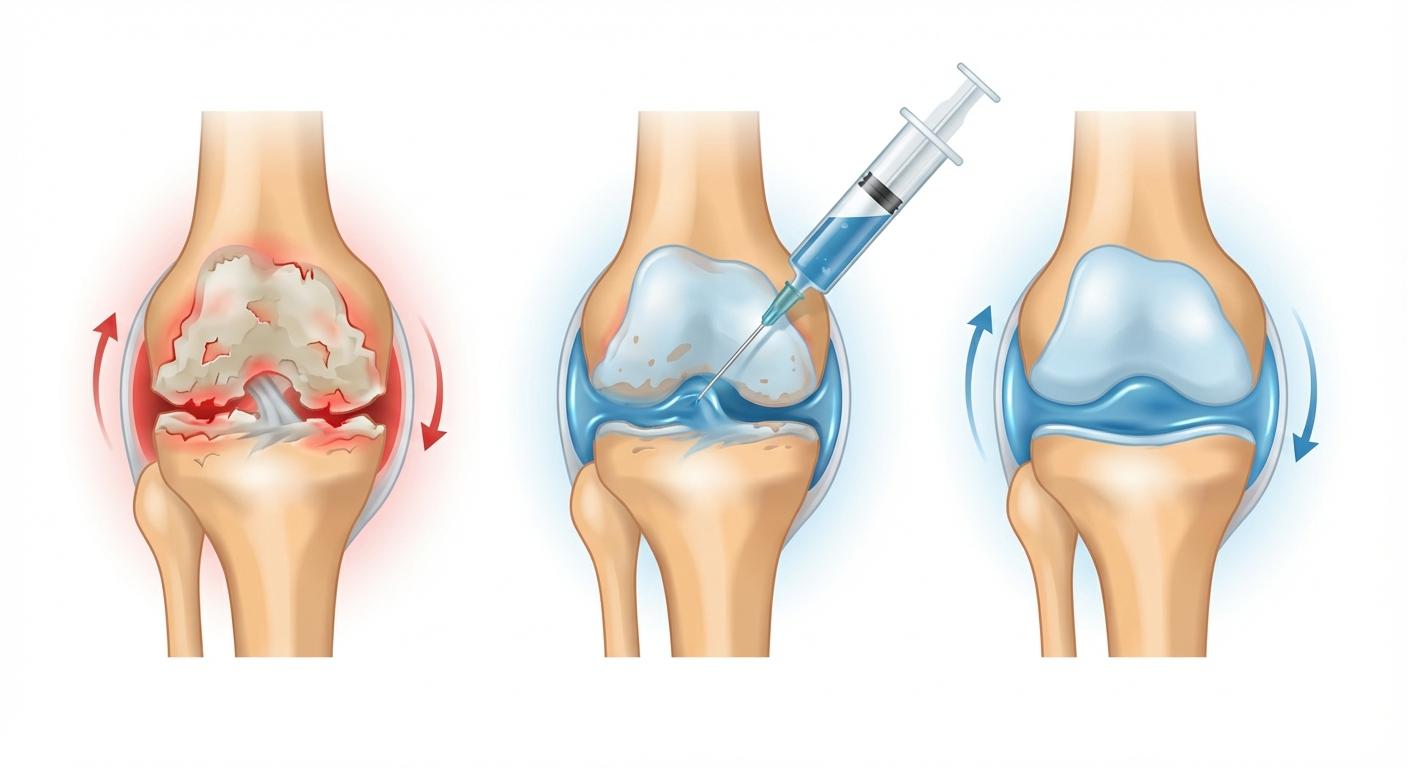
The science: Hyaluronic acid is a naturally occurring molecule in your body. Viscosupplementation supplements the depleted HA in your joint, restoring its viscoelastic properties — the ability to both flow (viscous) and bounce back (elastic).
Who Is a Good Candidate for Viscosupplementation?
Viscosupplementation is most effective for patients with knee osteoarthritis who want to avoid or delay surgery. You may be a candidate if any of the following apply:
Knee osteoarthritis (stages 2–4)
Most effective for moderate to severe cartilage loss confirmed by X-ray
Inadequate relief from conservative treatment
Physical therapy, NSAIDs, or lifestyle changes have not provided sufficient relief
Want to delay or avoid surgery
Patients who are not ready for or want to postpone knee replacement
Active individuals seeking mobility
Want to return to walking, gardening, golf, travel, and daily activities
Cortisone no longer effective
Cortisone injections provide diminishing returns or are limited by frequency
Age 40 and older
Osteoarthritis is most common in adults over 50, but younger patients with joint damage may also qualify
Not sure if you qualify? The only way to know is through a clinical evaluation with imaging. During your no-obligation visit, our physicians will review your X-rays (or order new ones) and determine if viscosupplementation is the right treatment for your specific condition.
The Joint Relief Institute Difference
Not all viscosupplementation is the same. Where and how you receive treatment matters as much as the gel itself.
Fluoroscopy-Guided Precision
Every injection at JRI uses real-time X-ray imaging for 100% confirmed accurate placement. Studies show blind injections miss the joint up to 30% of the time.
Injection Accuracy
40,000+ Patients Treated
We specialize exclusively in non-surgical knee and shoulder pain relief. Viscosupplementation is our core expertise — not a side procedure.
Procedures Performed
12+ FDA-Approved Options
Most practices offer 1 or 2 gels. We carry 12+ FDA-approved products and match the right gel to your specific condition, allergies, and insurance.
Gel Options Available
Why Fluoroscopy Matters
Up to 30% of injections miss the joint entirely
Real-time X-ray confirms every injection reaches the joint
FDA-Approved Viscosupplementation Options
Joint Relief Institute carries 12+ FDA-approved gels. Your physician selects the best option based on your arthritis severity, allergies, insurance coverage, and treatment goals.
| Product | Injections |
|---|---|
| Synvisc-One | 1 |
| Euflexxa | 3 |
| Gel-One | 1 |
| Supartz FX | 3–5 |
| Monovisc | 1 |
| Orthovisc | 3–4 |
| Visco-3 | 3 |
| Hyalgan | 3–5 |
| GenVisc 850 | 3–5 |
| Triluron | 3 |
| Durolane | 1 |
| Arthrosamid | 1 |
Want the full comparison? Read our detailed guide: Types of Gel Injections for Knees — Complete Comparison Guide
Have an avian allergy? Non-avian options (Euflexxa, Durolane) are available. Ask your physician during your evaluation.
What to Expect: The 4-Step Procedure
Viscosupplementation at JRI is a simple, in-office procedure. No hospital, no general anesthesia, no downtime.
Numb the Area
A local anesthetic is applied to the knee to minimize any discomfort. Most patients report little to no pain during the procedure.
Image with Fluoroscopy
Real-time X-ray imaging (fluoroscopy) guides the needle directly into the joint space. This ensures 100% accurate placement, even in severely narrowed joints.
Inject the Gel
FDA-approved hyaluronic acid gel is injected into the knee joint. Your physician selects from 12+ gel options based on your specific condition and needs.
Walk Out the Same Day
The entire procedure takes about 45 minutes. You walk out of the office the same day. No hospital stay, no general anesthesia, no recovery downtime.
Total procedure time
Recovery downtime
Walk out of the office
Many patients experience relief after their first visit. Individual results may vary.
Viscosupplementation Cost & Insurance Coverage
One of the most common questions we hear: “How much will this cost me?” For most patients, the answer is surprisingly affordable.
of patient visits resulted in little to no out-of-pocket cost.*
Based on analysis of 400K+ patient visits at Joint Relief Institute
We verify your copay before you come in — no surprise bills
Self-Pay? Affordable Options Available.
No insurance? No problem. We offer competitive self-pay pricing for viscosupplementation and will tell you the exact price upfront before treatment. Call us to discuss your options.
Check Your Insurance Coverage
Medicare and most insurance plans accepted
What Patients Say About Viscosupplementation at JRI
“I was told cortisone was my only option until I was ready for surgery. Then I found JRI and got gel injections. That was two years ago and I'm still playing golf every week.”
“The fluoroscopy made all the difference. I had gel injections at another clinic without imaging and got no relief. At JRI, I felt improvement within two weeks.”
“My Medicare covered everything. I paid nothing out of pocket. The staff verified my coverage before I even came in. No surprises, just relief.”
More Patient Experiences
My knees feel wonderful and brand new after my injections. I was scared of surgery but this worked beautifully.
My sister got relief with just 3 injections — no surgery needed! Anybody with knee pain, I recommend here. Now I'm ready for my cruise!
I wish that I had gone to them earlier. They told me exactly what my Medicare would cover. Courteous, concerned, and highly professional.
Frequently Asked Questions About Viscosupplementation
Q1. What is viscosupplementation?
Viscosupplementation is an FDA-approved treatment for knee osteoarthritis. It involves injecting hyaluronic acid (HA) gel directly into the knee joint to restore natural lubrication and cushioning. Healthy knee joints contain synovial fluid rich in hyaluronic acid, which acts as a shock absorber and lubricant. When osteoarthritis breaks down cartilage, this natural fluid becomes thin and less effective. Viscosupplementation replaces what the body has lost, reducing friction between bones and providing pain relief that typically lasts 6 to 12 months.
Q2. Does Medicare cover viscosupplementation?
Medicare Part B covers viscosupplementation (hyaluronic acid injections) for patients with documented knee osteoarthritis who have tried conservative treatment for at least 3 months. At Joint Relief Institute, 93% of patient visits resulted in little to no out-of-pocket cost.* We verify your specific Medicare coverage before your appointment so there are no surprises. Call (800) 238-9307 to check your eligibility.
Q3. How long does viscosupplementation last?
Most patients experience pain relief lasting 6 to 12 months from a single course of viscosupplementation. Some patients report longer-lasting results. The treatment can be repeated every 6 months, and many patients experience cumulative improvement with successive courses. Duration of relief varies depending on the severity of your arthritis, activity level, and the specific gel product used.
Q4. Is viscosupplementation painful?
Most patients report minimal discomfort during viscosupplementation. At Joint Relief Institute, we numb the area with a local anesthetic before the injection. Our fluoroscopy-guided technique uses real-time X-ray imaging to guide the needle precisely, which means fewer needle adjustments and less discomfort compared to blind injections. Many patients say the procedure was far less painful than they expected.
Q5. Viscosupplementation vs. cortisone: what is the difference?
Cortisone injections reduce inflammation and provide fast pain relief (2 to 3 days), but the effect typically lasts only 6 to 12 weeks and is limited to 3 to 4 injections per year. Repeated cortisone may accelerate cartilage loss. Viscosupplementation works differently. It restores the joint's natural lubrication and cushioning, providing relief that lasts 6 to 12 months per course with no limit on repeat treatments. Hyaluronic acid may also have a chondroprotective effect, potentially helping to preserve remaining cartilage. At JRI, we often combine both approaches: cortisone for immediate inflammation relief and viscosupplementation for long-term cushioning.
Q6. How much does viscosupplementation cost without insurance?
The cost of viscosupplementation varies depending on the specific gel product and the number of injections in the series. With insurance, most patients pay little to nothing. At Joint Relief Institute, 93% of patient visits resulted in little to no out-of-pocket cost.* For self-pay patients, we offer competitive pricing and will provide the exact cost upfront before treatment. Call (800) 238-9307 for a cost estimate based on your situation.
Q7. Why does fluoroscopy-guided viscosupplementation matter?
Studies show that blind (unguided) knee injections miss the joint space up to 30% of the time. In osteoarthritic knees where the joint space is narrowed, accuracy becomes even more critical. Fluoroscopy uses real-time X-ray imaging to confirm the needle is positioned precisely within the joint before the gel is injected. This ensures 100% accurate placement, maximizing the effectiveness of every injection. Joint Relief Institute uses fluoroscopy for every viscosupplementation procedure.
Q8. Who is not a good candidate for viscosupplementation?
Viscosupplementation may not be appropriate for patients with active knee infections, skin diseases near the injection site, or known allergies to hyaluronic acid or avian-derived products (some gels are made from rooster combs, though non-avian options like Euflexxa and Durolane are available). Patients with significant joint instability or severe deformity may benefit more from surgical intervention. During your no-obligation evaluation, our physicians will determine if viscosupplementation is appropriate for your specific condition.
4 Chicagoland Locations
Viscosupplementation available at all four Joint Relief Institute clinics in the greater Chicago area.
Find Out If Viscosupplementation
Is Right for Your Knees
Our board-certified physicians will evaluate your condition, review your imaging, and determine if viscosupplementation is the right treatment for your specific situation.
If gel injections aren't the right fit, we'll tell you honestly — and help you find the specialist who can.
Or call us: (800) 238-9307
Sources
[1] EUROVISCO Consensus Guidelines for Hyaluronic Acid Viscosupplementation in Knee OA. J Orthopaedic Surgery and Research, 2024.
[2] Accuracy of Blind vs. Image-Guided Intra-Articular Knee Injections. J Clinical Medicine, 2022.
[3] Long-Term Outcomes of Single versus Multiple Courses of Viscosupplementation. PMC, 2021.
[4] Bannuru RR, et al. Therapeutic Trajectory of Hyaluronic Acid versus Corticosteroids in the Treatment of Knee Osteoarthritis. Arthritis & Rheumatism, 2009.
[5] Effect of Intra-articular Triamcinolone vs Saline on Knee Cartilage Volume. JAMA, 2017.
[6] Medicare Coverage Database: Hyaluronic Acid Injections. CMS, 2025.